Look at the most talked-about cars of the last few years and a pattern emerges that should be impossible: the future looks like the past. The Hyundai Ioniq 5 wears sharp 1970s creases and pixelated lighting. The new Land Cruiser went boxy and upright like its ancestors. Renault revived the Renault 5 and the Renault 4 as EVs. Ford brought back the Bronco's retro silhouette. Across the industry, the most forward-looking technology (electric drivetrains) keeps arriving wrapped in the styling of decades ago. This is retro-futurism, and it's the defining design movement of the moment. Here's why it happened, and why it works.
What retro-futurism actually is
Retro-futurism isn't simple nostalgia. Nostalgia is a faithful copy of the past. Retro-futurism is the collision of past visions of the future with present-day technology, taking the optimistic, clean-lined, boxy-and-bold design language of the 1970s and 80s and pairing it with the powertrain and tech of today. It's the future as the past imagined it, finally built with the tools to do it right.
The result has a specific emotional texture: familiar and novel at once. You recognize the shape on some deep level, which makes it instantly likeable, but the details (the lighting signatures, the surfacing, the lack of an engine) tell you it's new. That double signal is enormously powerful, and designers have figured out how to exploit it.
The Ioniq 5: the breakout
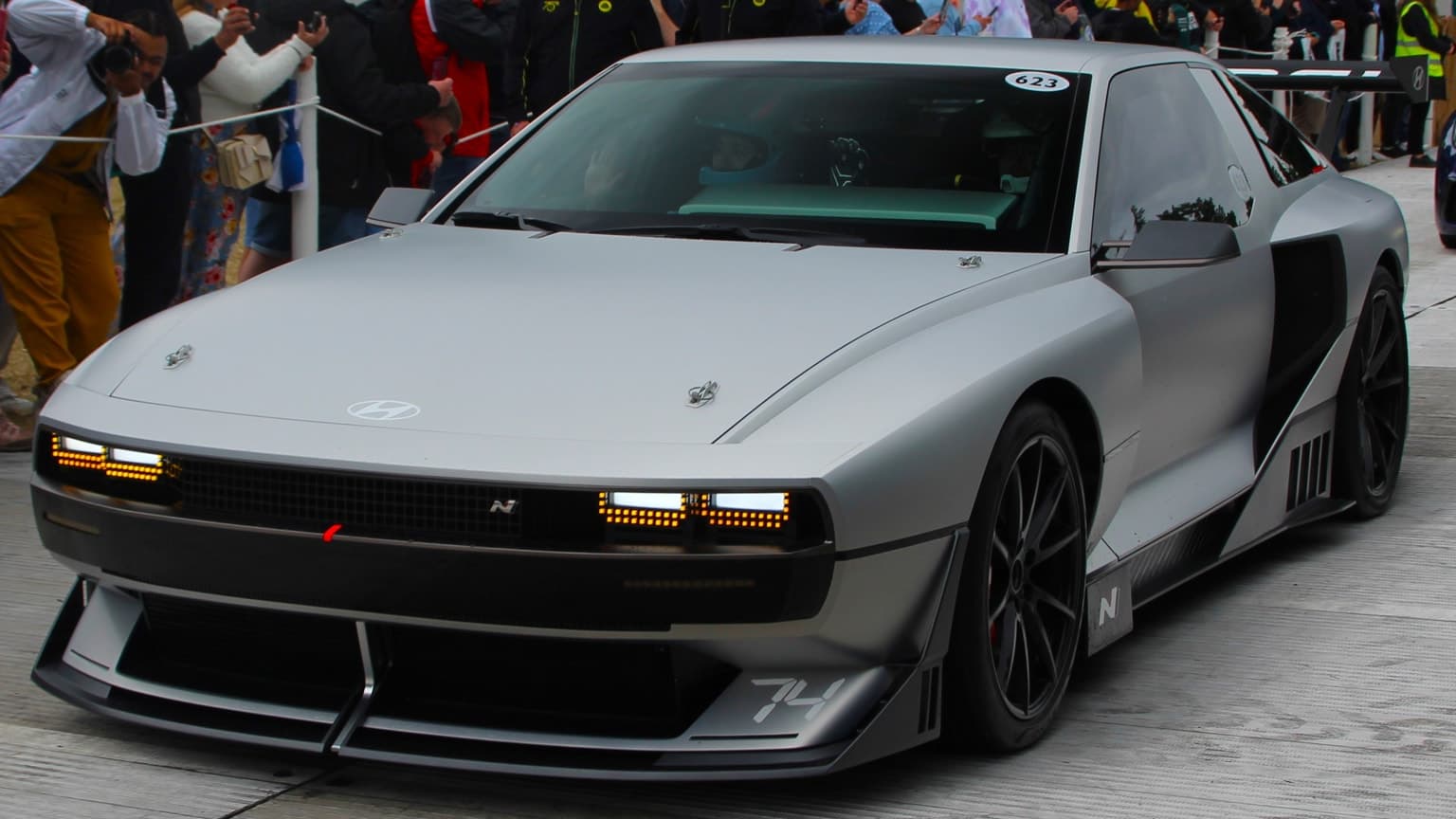
If one car crystallized the movement, it's the Hyundai Ioniq 5. It wowed press and public alike with sharp-edged 1970s-inspired bodywork and unashamedly 80s "pixelated" lighting details (Parametric Pixels, in Hyundai's language) that turned a humble matrix of square LEDs into a signature recognizable from a block away.
What made the Ioniq 5 a watershed wasn't just that it was attractive; it was that it proved retro-futurism could sell and signal innovation simultaneously. A clean-sheet EV from a brand once seen as a value player suddenly became a design icon, winning awards and reframing Hyundai as a style leader. Every "pixel-lit boxy EV" since owes it a debt.
The boxy renaissance
The movement's most visible symptom is the return of the box. After two decades of soft, melted, aerodynamic blobs, manufacturers are mining their 1970s and 80s archives for upright, slab-sided, honest geometry: the sixth-generation Ford Bronco, the Nissan Frontier's Hardbody throwback, the squared-off 2024 Land Cruiser.
There's substance behind the style. Boxy shapes are honest: they signal capability and durability rather than slipperiness, and they package interiors more efficiently (a flat-sided EV is easier to fit a battery and a roomy cabin into). But mostly the box is back because the blob era exhausted itself. When everything looks like a bar of soap, the most striking thing you can do is draw a straight line. The box reads as confident, retro and refreshingly un-fussy all at once.
The EV restomod: the purest expression
The movement reaches its most fascinating extreme in the EV restomod, taking an actual classic and reimagining it with an electric heart. The standout is designer Ora Ïto's reinterpretation of the 1971 Renault 17, an electric concept that stays true to the original's avant-garde roots while integrating modern propulsion and Ïto's "simplexity" philosophy: keeping the classic's iconic elements while stripping away the noise.
These projects are retro-futurism in its purest form, because they're literally the past brought into the future: an old shape, preserved and celebrated, running on tomorrow's drivetrain. They also point to where heritage brands are heading: Renault, Hyundai and others have realized that their back catalogues are design goldmines, and that an EV is the perfect excuse to mine them. The old shape carries the emotion; the new powertrain carries the future.
Why now? The psychology of the wave
The timing isn't coincidental. Retro-futurism surges in moments of uncertainty and rapid change, and the transition to electric is exactly that. EVs threatened to make all cars feel like anonymous appliances: silent, similar, soulless. Retro-futurist styling is the antidote. It gives an unfamiliar, sometimes intimidating new technology a warm, familiar, human face. You're more likely to embrace the radical novelty of an electric drivetrain if it arrives looking like the car your cool uncle drove in 1978.
It also taps the same nostalgia economy powering every other corner of culture right now: vinyl, film cameras, Y2K fashion, the JDM revival. A generation overwhelmed by the relentless churn of the new reaches instinctively for the warmth of the recognizably old. Retro-futurism in car design is the same impulse that's reviving the Walkman aesthetic, just rendered in sheet metal.
The risk: archive raiding can run dry
The honest caveat: a movement built on mining the past has a ceiling. There are only so many beloved old shapes to revive, and the difference between inspired by and cosplaying is thin. Done well (Ioniq 5, Renault 5), retro-futurism feels fresh. Done lazily, it's a pastiche that trades on borrowed emotion without adding anything. The best practitioners use the past as a starting grammar and then say something new with it. The worst just photocopy a 1970s brochure.
The takeaway
The retro-futurism boom is the defining car-design story of the moment, and it's smarter than it looks. By wrapping the genuinely radical technology of electrification in the warm, familiar, optimistic design language of the 1970s and 80s (pixel lighting, boxy honesty, reborn icons, EV restomods of classics), designers solved the appliance problem. They made the future feel like something we already love.
It works because it speaks to two things at once: a craving for novelty and a craving for comfort, satisfied in a single object. The cars that nail it (the Ioniq 5, the Renault 5, Ora Ïto's electric R17) are among the most beloved designs of the decade. The future, it turns out, looks best when it remembers where it came from.