Every hypercar maker claims lineage. Few can actually point to the car that invented the modern hypercar and say "we made that too." McLaren can. The McLaren F1, launched in 1992, set the template (central driving position, gold-lined engine bay, a top speed that stood as a record for years), and everything since has been measured against it. So when McLaren names a new Ultimate Series flagship the W1, the W standing for the same thing the F stood for, it's not subtle. It's a claim to the throne.
The good news: the numbers back up the swagger.
1,275 horsepower, and how it gets there
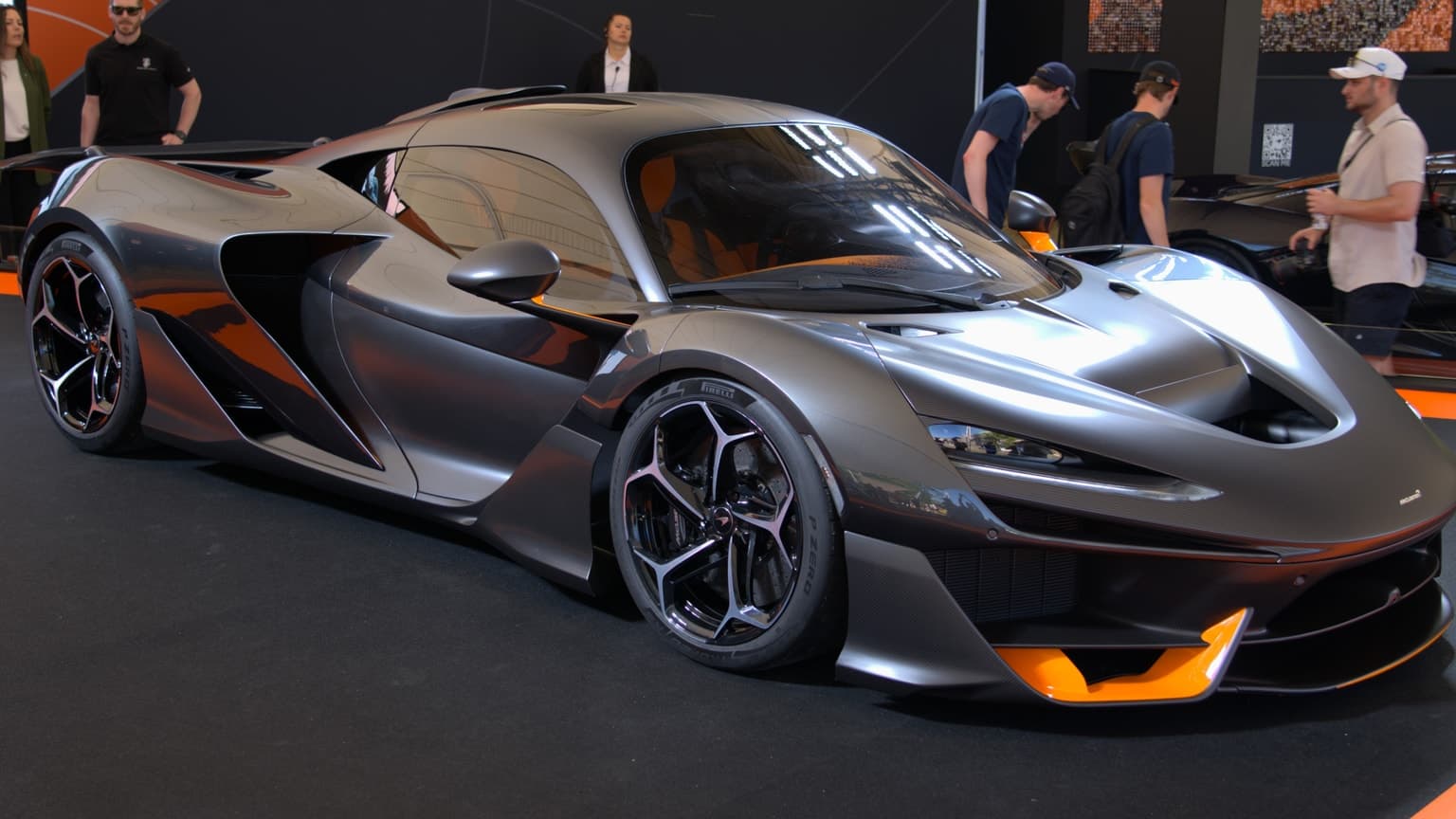
The W1 produces 1,275 horsepower through McLaren's most advanced hybrid powertrain to date: a high-revving twin-turbo V8 paired with an electric motor and a compact battery pack. The headline performance claim is 0–124 mph in 5.8 seconds, a figure that sounds abstract until you remember that's nearly twice the distance of a standard 0–62 sprint, covered in under six seconds.
What matters more than the raw figures is the philosophy. McLaren has always chased lightness and aero efficiency over brute force, and the W1 follows that doctrine: the hybrid system isn't there to add a token "eco" mode, it's there because instant electric torque fills the gaps a turbocharged engine leaves and because the motor enables active aerodynamics and torque vectoring that a pure combustion car can't match. This is hybridization as performance tool, not as a compliance box.
Only 399 will exist
McLaren is capping W1 production at 399 examples. That's a deliberate echo of hypercar exclusivity playbooks: keep supply below demand, guarantee the cars appreciate, and ensure every example is effectively pre-sold to existing collectors before the public ever gets a chance.
If 399 sounds arbitrary, it isn't far off the P1's 375-unit run. McLaren's Ultimate Series has always been about engineered scarcity: these are not cars you walk into a dealership and order. They're allocated, courted, earned. By the time a W1 is revealed publicly, the build slots are gone. That's the model, and it's why these machines function as much as financial instruments as automobiles.
The F1, the P1, and now the W1
To understand why the W1 matters, you have to understand the family tree. The F1 (1992) was the analog god: naturally aspirated BMW V12, manual, no driver aids, pure. The P1 (2013) was the hybrid pioneer, one of the "holy trinity" alongside the Ferrari LaFerrari and Porsche 918, the cars that proved electrification could make a hypercar faster, not slower. The W1 is the third act: the car that takes everything learned from a decade of hybrid hypercars and refines it into McLaren's definitive statement of the electrified era.
And McLaren isn't stopping there. Reporting suggests a separate, even more extreme hybrid hypercar (internally referred to as a P1 successor) is also in the pipeline, meaning Woking is building out a whole hierarchy of Ultimate Series machines rather than relying on a single halo. The W1 sits at the top of that pyramid for now.
Why the W1 reads as a culture object, not just a car
For HYPE's audience, the W1's significance isn't only mechanical. It's a symbol of a specific moment: the last great gasp of the combustion-rooted hypercar before full electrification swallows the category. The twin-turbo V8 at the W1's heart is, in all likelihood, the kind of engine that won't survive another generation of regulation. Every hybrid hypercar revealed now carries a faint elegiac quality: these are the machines bridging the era of noise and the era of silence.
That's what makes the W1 collectible in a deeper sense than rarity alone. It's a time capsule of where performance engineering stood in the mid-2020s: combustion and electrification working in tandem, active aero, carbon everywhere, hand-built in tiny numbers. A decade from now it'll be remembered the way the P1 is now, as a marker of a transition.
The design language
Visually, the W1 carries McLaren's evolved aero-sculpture language: a body shaped less for beauty than for managing airflow, with active surfaces that change geometry depending on speed and mode. The aesthetic is function made visual: ducts, channels and a deployable rear wing that all exist for measurable downforce, not decoration. It's the anti-Ferrari approach in some ways: where Maranello chases drama, McLaren chases the number on the data logger and lets the looks follow.
Inside, expect McLaren's signature driver-centric minimalism: exposed carbon, a focus on the controls that matter, and the kind of ergonomic obsession that made the F1's central seat a legend.
The takeaway
The McLaren W1 is a car doing two jobs at once. First, it's a flat-out engineering flex (1,275 horsepower, a sub-six-second 0–124 sprint, 399 hand-built examples) that puts McLaren back in direct conversation with Ferrari and Bugatti at the apex of the market. Second, and more interestingly, it's a lineage statement: the deliberate naming, the F1-to-P1-to-W1 throughline, the message that McLaren didn't just enter the hypercar game, it defined it.
In an era when every legacy brand is scrambling to prove it can stay relevant through electrification, the W1 is McLaren's reminder that it's been writing this story since 1992. The throne, Woking is saying, was never up for grabs.