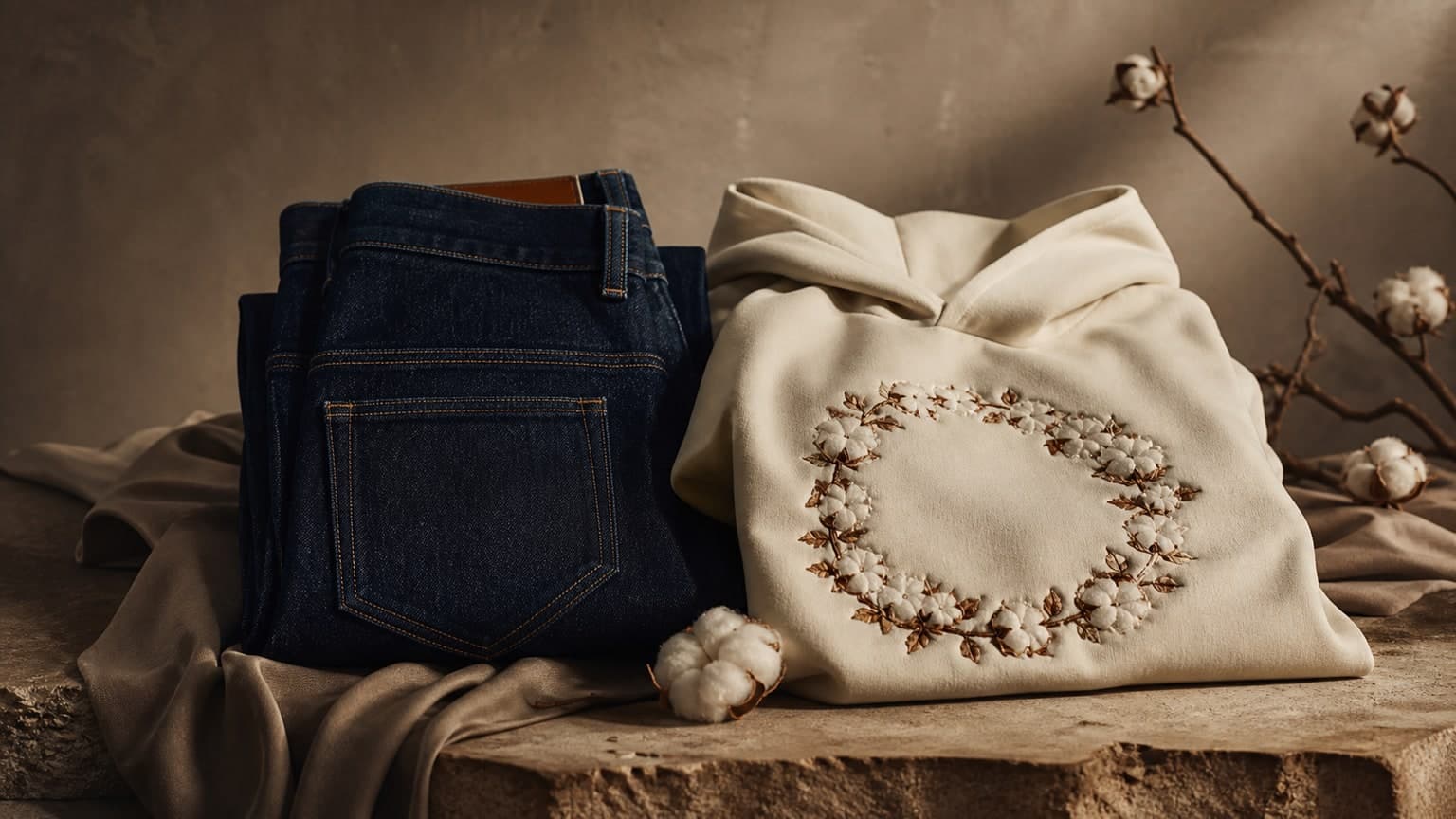
Most streetwear sells you a feeling: cool, belonging, the rush of a successful cop. Denim Tears sells you a history lesson. Since Tremaine Emory founded the label in 2019, every piece has been a vehicle for a single, unflinching subject: what Emory calls "the plight and glory of the African diaspora." The recurring cotton wreath motif, a circle of cotton bolls that adorns his jeans and hoodies, references the legacy of slavery and the American cotton industry directly. It is the rare streetwear graphic that asks you to think before you buy. And in 2026, Emory is pushing that project further than ever.
A Campaign That Plays Like Liner Notes
Denim Tears' Spring/Summer 2026 collection arrived with a campaign built around Lauryn Hill and her family, a choice that tells you everything about how Emory operates. He doesn't cast for clout; he casts for meaning. Hill is one of the most singular voices in the history of Black American music, an artist whose work fused gospel, hip-hop, reggae and soul into something that felt like cultural memory set to a beat. Putting her at the center of a fashion campaign isn't a celebrity endorsement. It's a citation.
The collection itself extended Emory's diaspora goods, introducing a peace-sign variation of the Cotton Wreath, a small but pointed evolution of the motif from a symbol of historical reckoning into something that also gestures toward resolution and hope. That's the Emory move: take a heavy symbol, then complicate it. The cotton wreath has never been a logo to him. It's an argument he keeps developing season after season.
Streetwear as Total Art
What makes Denim Tears genuinely different from its peers is that Emory treats the brand as a multimedia practice rather than a product line. The clothing is one channel; the campaigns, the collaborators, the references, and the conversations they spark are the rest. He has been called streetwear's best storyteller right now, and the label functions less like a brand and more like a recurring exhibition with a retail component attached.
That approach connects streetwear to the broader currents of contemporary art and music in a way few labels even attempt. Emory's collaborators and influences run from fine art to literature to the deep catalog of Black music, and the clothes work as a kind of curation: wearable footnotes pointing you toward the source material. Buy a pair of his jeans and you're also being handed a reading list, a playlist, a history you may or may not have known.
The Hardies Conversation
This instinct for dialogue showed up sharply in the FW25 collaboration with Tyshawn Jones's Hardies Hardware. On paper it's a streetwear-meets-skate-brand collab; in practice it was a conversation between two distinct lineages. Jones, a celebrated pro skater, built Hardies on skateboarding's raw, self-determined energy. Emory brought his diaspora framework. The collaboration's "Fist Wreath" graphic (a hybrid of the raised fist and the cotton wreath, set across hoodies and open-hem sweatpants) literally fused the two worldviews into one symbol.
That's the difference between a great collab and a logo mashup. Most brand pairings ask "what do our two logos look like next to each other?" Emory asks "what do our two histories say to one another?" The Fist Wreath is an answer to a question most collaborations never bother to pose.
Building the Means of Production
The most consequential 2026 development isn't a graphic at all. It's infrastructure. For the first time, Denim Tears is making its own denim, with custom-designed rivets, hardware bearing the Cotton Wreath logo, and stitching patterns that nod to historical garments. The initial collection runs $250–$450, with more drops to follow.
This matters more than it might seem. Until now, Denim Tears largely applied its storytelling to other people's blanks: Levi's denim, Converse silhouettes, collaborative canvases. Making the denim in-house means Emory now controls the medium as well as the message. For a brand whose entire subject is the cotton industry and the labor behind American textiles, taking ownership of the actual manufacturing of cloth is almost too poetic to be accidental. The man who built a brand on the history of cotton is now making his own.
Going Global
All of this is happening as Denim Tears expands internationally, with a planned move into Tokyo establishing its first outpost outside New York. That's a significant test. Emory's storytelling is rooted deeply in the specifics of the American Black experience; translating that to a global audience without flattening it into decontextualized graphics is a genuine challenge. But Emory has consistently refused the easy version. There's little reason to think Tokyo will be where he starts cutting corners.
The Takeaway
Denim Tears is the clearest proof that streetwear in 2026 can carry real weight: that a hoodie can be an essay, a collab can be a conversation, and a graphic can be a memorial. In a category increasingly obsessed with quiet luxury and resale spreadsheets, Emory keeps insisting that clothing can mean something. The in-house denim, the Lauryn Hill campaign, the Fist Wreath: each is a refusal to let streetwear be only about cool. History is heavy. Emory has spent six years proving you can wear it anyway.