Spend ten minutes in watch culture and you'll hit a wall of vocabulary: GMT, chronograph, perpetual calendar, tourbillon, moonphase, power reserve. Insiders sling these terms around as if everyone was issued a glossary at birth. They weren't. So here's the plain-English version: what a complication actually is, what the common ones do, and which are genuinely useful versus pure flex.
First: what's a "complication"?
In watchmaking, a complication is any function a watch performs beyond simply telling the time. That's the entire definition. A date window is a complication. A stopwatch is a complication. A device that tracks the phases of the moon is a complication. The more of them a watch combines, and the more cleverly, the more "complicated" and, usually, expensive it becomes. A watch with no complications, just hours/minutes/seconds, is called time-only, and there's an entire school of taste that considers that the purest form.
Now, the ones you'll actually encounter:
The date (and its fancier cousins)
The simplest and most common complication is a date display, usually in a small window. Step it up and you get the day-date (day of the week spelled out, as on the Rolex of the same name). The annual calendar knows how many days are in each month and only needs correcting once a year, at the end of February. The perpetual calendar is the real flex: it accounts for leap years and won't need adjusting until the year 2100. That's a serious feat of mechanical memory, packed into gears.
Chronograph
A chronograph is a stopwatch built into a watch. You'll recognize it by the pushers flanking the crown and the extra sub-dials on the face. Press to start timing an event, press again to stop, press the reset to zero it. Under the hood it uses additional gear trains that engage with the main movement, with the pushers controlling start, stop and reset while the watch keeps accurate time throughout. The Rolex Daytona, Omega Speedmaster and TAG Heuer Monaco are all famous chronographs. It's arguably the most genuinely useful complication, and certainly the most beloved.
GMT / dual time
A GMT watch lets you read more than one time zone at once. It adds a fourth hand that circles the dial once every 24 hours (rather than 12) and points to a 24-hour scale, usually on the bezel. Set it to your home time while the regular hands show wherever you are. It's the traveler's complication, born from Pan Am pilots in the 1950s, and it's become hugely popular again as people move and travel more. Practical, legible, and it looks great with a two-color "Pepsi" or "Batman" bezel.
Moonphase
The moonphase shows the current phase of the moon via a little rotating disc visible through an aperture on the dial. Is it useful? Almost never, unless you're a sailor or a romantic. Is it charming? Enormously. It's one of the oldest complications and remains a favorite precisely because it's poetic rather than practical. A good moonphase is a small piece of the night sky on your wrist.
Power reserve
A power-reserve indicator is a gauge showing how much wind is left in the mainspring, essentially a fuel gauge for a mechanical watch. Handy on watches you don't wear daily, since it tells you at a glance whether the watch is about to stop. Increasingly common, genuinely useful, and visually interesting.
Tourbillon
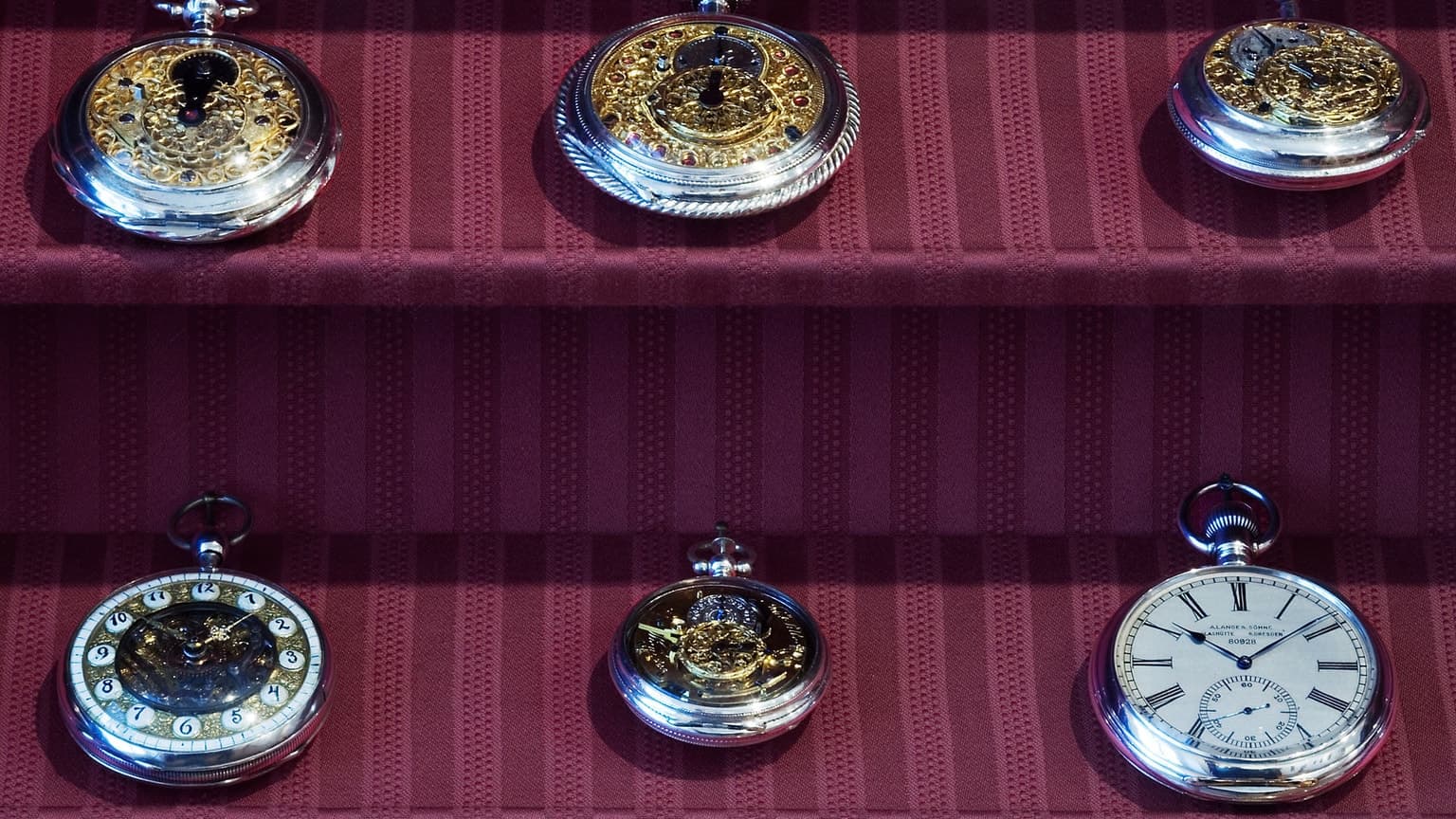
Now the big one, the complication that gets stuck on million-dollar watches and hip-hop wrists alike. The tourbillon was patented by Abraham-Louis Breguet in 1801. It places the balance wheel and escapement (the timekeeping heart of the watch) inside a small rotating cage that makes a full revolution, typically once a minute. The original purpose was to average out the effect of gravity on a pocket watch sitting in one position, improving accuracy.
Here's the honest truth: in a modern wristwatch that moves around all day, the tourbillon does almost nothing for accuracy. Its real value now is as a display of watchmaking skill and a mesmerizing thing to watch spin. It's the ultimate "because we can" complication: pure horological theater. There's nothing wrong with that, as long as you know that's what you're paying for.
Minute repeater (the deep end)
If you want to know how far this rabbit hole goes: a minute repeater chimes the time out loud on demand, using tiny hammers striking gongs: one tone for hours, another for minutes. It's one of the most difficult complications to make well, and the great ones cost as much as a house. You'll never need it. It's also one of the most beautiful objects humans make.
Which ones actually matter?
For most people, the genuinely useful complications are the date, the chronograph and the GMT. Everything beyond that (perpetual calendars, tourbillons, minute repeaters) is about craftsmanship, history and flex rather than function. And that's completely fine. Mechanical watches stopped being the most accurate way to tell time the moment quartz arrived in the 1970s; a $20 digital watch keeps better time than a tourbillon. We wear mechanical watches because they're beautiful, clever and unnecessary.
The takeaway
Complications are the grammar of watch culture. Knowing the difference between a chronograph and a GMT, or why a tourbillon costs a fortune but doesn't make your watch more accurate, is the line between nodding along and actually understanding what's on someone's wrist. Start with the useful three, appreciate the rest as the gorgeous over-engineering they are, and you'll never be lost in a watch conversation again.