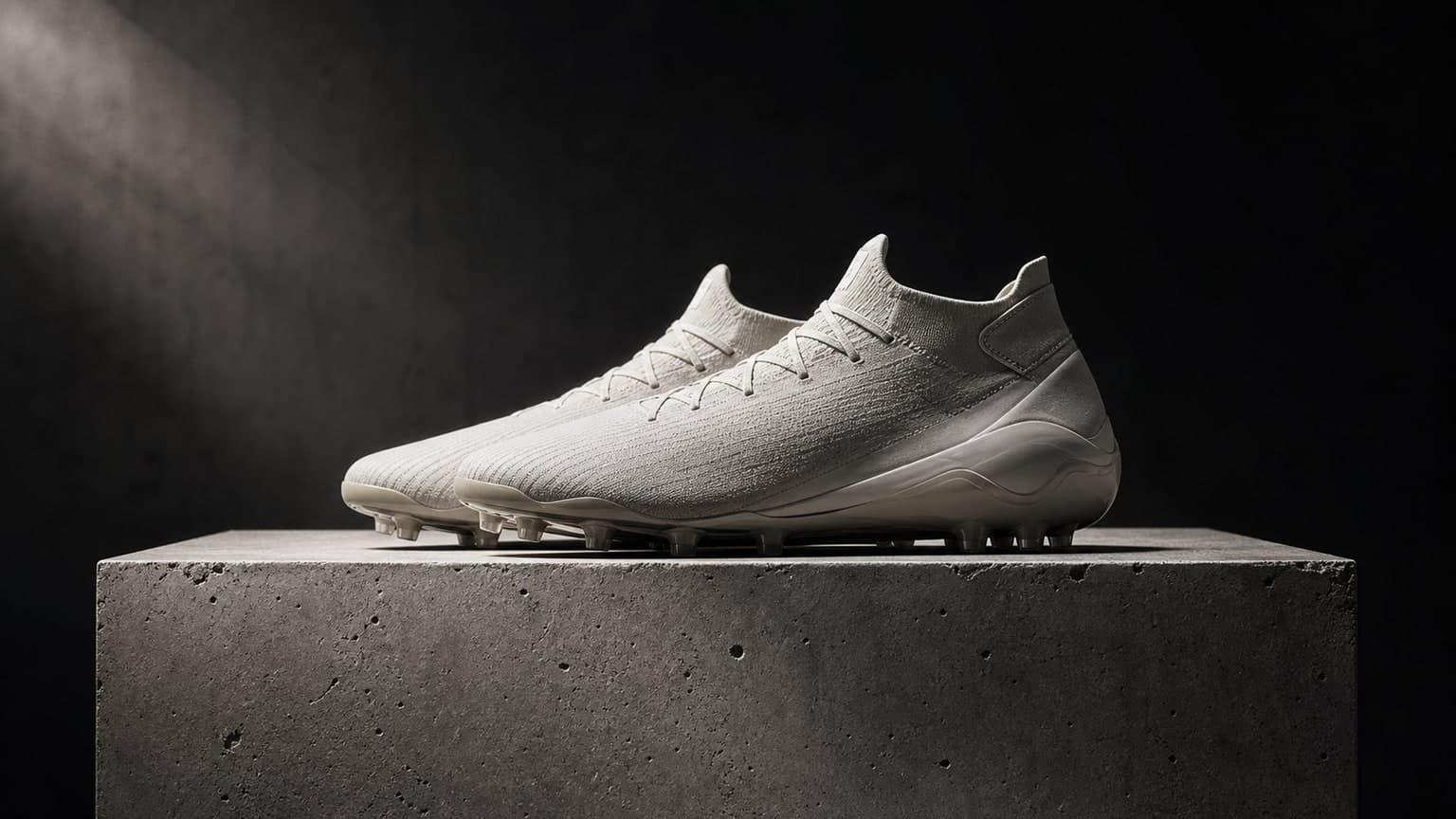
There was a time when a musician's relationship to sneakers ended at the signature shoe: a logo, a colorway, a press shot. That era is over. In 2026, artists aren't just lending their names to footwear; they're running design houses, fronting luxury campaigns, and shaping how the biggest sportswear moments of the year actually look. The clearest signal: music is now embedded in the World Cup itself.
NOCTA on the world stage
Drake's Nike sub-label NOCTA is designing the Canadian capsule for Nike's 2026 World Cup collection, a part of an ambitious multi-brand push tied to the tournament. Let that land for a second. A rapper's imprint is shaping official national-team adjacent product for the single biggest event in global sport, hosted across North America in 2026.
That's a categorically different level than a celebrity collab. It positions NOCTA not as a vanity project but as a legitimate design entity inside the Nike machine, trusted with one of the year's marquee moments. The anticipated chrome-heavy energy NOCTA has cultivated (including buzz around an Air Force 1 Low that fuses rock-luxury hardware with the platform's classic silhouette) fits the maximalist, statement-driven mood of 2026 sneaker culture.
Action Bronson and the connoisseur's lane
If NOCTA represents music's mainstream sneaker power, Action Bronson represents its taste-making depth. His "Rosewater" collaboration on New Balance's 1906R in summer 2024 set a template for how the brand's 99X family operates at the music-and-sneaker intersection: thoughtful, materials-forward, and rooted in genuine sneaker obsession rather than brand-deal box-checking.
That influence keeps echoing. The ongoing 9060 colorway calendar includes a "No Sew" variation for 2026 that mirrors the construction approach of previous 1906R standouts, the kind of detail that only matters to people who actually care, which is exactly the audience Bronson speaks to. He's proof that an artist can move sneaker culture through credibility rather than reach.
Solange, Jacquemus and the luxury crossover
Then there's the high-fashion end. Singer and artist Solange Knowles appears in the campaign for the Nike x Jacquemus collaboration, a pairing that drags sportswear firmly into the luxury-runway conversation. Solange isn't there to sell a signature shoe; she's there as a cultural signifier, a way of telling the fashion world that this product belongs in a more rarefied room.
That's a different use of music's power. Where NOCTA brings scale and Bronson brings credibility, an artist like Solange brings aesthetic authority: the sense that the people with the best taste are paying attention. For a brand collaboration, that endorsement is the whole point.
K-pop and the fandom multiplier
No 2026 sneaker-and-music conversation is complete without K-pop. Collaborations between K-pop acts and labels like BAPE leverage the genre's global fan culture, pairing bold graphics with mobilized, hyper-engaged fan bases. The formula (music plus style plus fandom in one capsule) is ruthlessly effective. A drop tied to a major K-pop act doesn't just sell; it sells out, instantly, to a fandom that treats every release as an event.
This is arguably the purest expression of where the music-sneaker economy is heading: the artist isn't just a designer or a face, they're a distribution engine. The fandom is the demand.
Why music owns the sneaker now
Step back and the pattern is clear. Across the spectrum, from mainstream (NOCTA) to connoisseur (Bronson) to luxury (Solange) to fandom (K-pop), music has become the primary cultural lever sneaker brands pull. There's a logic to it. Sneakers were always about identity and belonging, and so is music. The two have been fused at the cultural level for decades; what's changed is that artists now have the leverage to design and direct, not just endorse.
It also reflects how artists make money in 2026. As streaming revenue plateaus, the smart move is to own product, merch and design: to convert cultural capital into tangible goods with real margins. A sneaker line, a design role, a campaign: these are assets, not ads. NOCTA designing for the World Cup is, among other things, a business decision about where the value is.
The risk of saturation
The flip side is dilution. When every artist has a shoe, a capsule or a campaign, the novelty thins. The collaborations that survive will be the ones with genuine point of view: Bronson's obsessive detail, NOCTA's consistent chrome-and-utility language, the specificity that makes a drop feel inevitable rather than opportunistic. The lazy celebrity collab is already getting harder to sell to a sneaker audience that can smell a cash grab from a mile away.
The takeaway
In 2026, the line between the recording booth and the design studio has effectively dissolved. Music doesn't just soundtrack sneaker culture anymore. It shapes it, from the World Cup pitch to the luxury runway to the resale market. The artists who treat it as craft rather than cash-out will define the era. The rest will be footnotes in someone else's release calendar.